

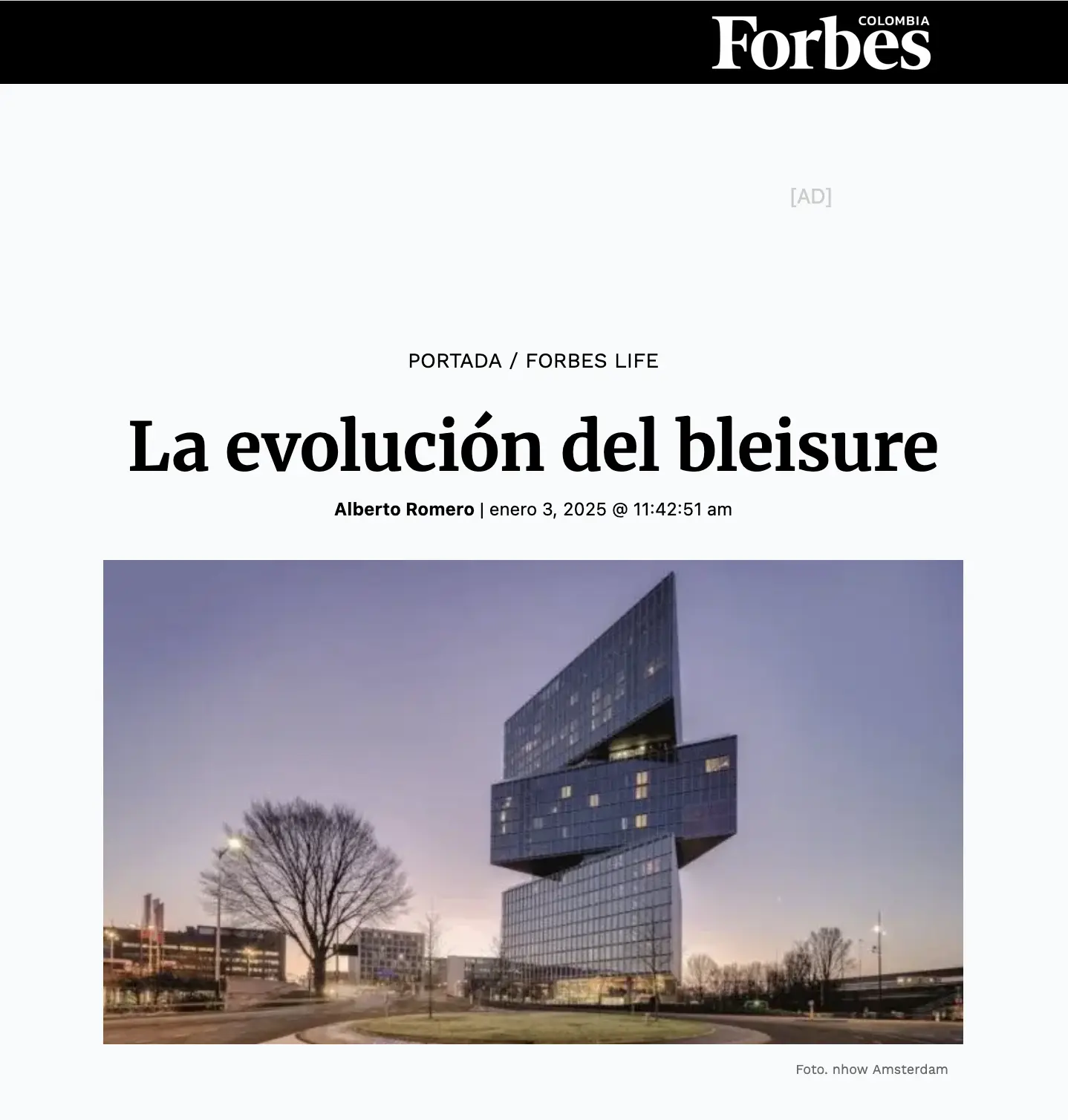
When you receive a call from Forbes—the world’s most prestigious business publication—asking to feature your work, it marks a significant milestone in your career. For me, that moment came when journalist Alberto Romero got interested in the spatial storytelling and hospitality art I have been developing across Europe’s nhow Amsterdam Rai Hotel and nhow Frankfurt Hotel.
The interview, published in January 2025, focused on the evolution of “bleisure”—a concept that blends business travel with leisure experiences. But more importantly, it positioned my work as a defining force in how the next generation of hotels will engage their guests through immersive design for spaces.
The Future of Hospitality According to Forbes
Forbes highlighted what I have been advocating for years: the future of hospitality design is not about adding decorative elements to a room. It is about creating meaningful, immersive experiences where art, architecture, and interior design converge to tell a story.
The article specifically quoted my vision for the next frontier: “The future of hospitality will unite augmented reality with meaningful, experiential encounters infused with artistic and cultural components.” This is the direction I see the industry moving—toward what I call “Hospitality 2.0,” where hotels become destinations themselves, not merely places to sleep.
The nhow Hotels as Living Laboratories
Forbes featured my work across two iconic nhow properties, each a distinct spatial artist interpretation of the cities they inhabit:
nhow Frankfurt: The article emphasized “The Money Circus” concept—my fierce, irreverent critique of global capitalism expressed through murals where historical currency figures become circus performers. Forbes captured how this art for spaces operates on multiple layers: it is visually striking, conceptually provocative, and impossible to ignore. From the guest’s bed, the artwork unfolds across both walls and ceiling, creating an immersive narrative that transforms the room into a commentary on wealth, power, and the absurdity of the financial system.
nhow Amsterdam Rai: The publication highlighted how I organized the entire hotel’s artistic concept around the four cardinal directions, with each wing celebrating unexpected cultural fusions—Japanese-Indian, Neerlandish-Scottish, African-Andean. This is spatial storytelling at its most sophisticated: every guest’s journey through the hotel becomes a voyage through cultural boundaries, visually reinforced by the art they encounter at every turn.
Why Forbes Took Notice
The reason a publication as rigorous as Forbes featured this work is because it demonstrates something increasingly rare in the hospitality industry: a spatial designer who thinks like a strategist, not just an artist. My work for these hotels isn’t about aesthetics alone; it is about ROI, guest engagement, social media viralization, and emotional loyalty.
When guests stay in a nhow hotel, they do not just observe art—they participate in it. They photograph it, they share it, they become protagonists in the narrative. This transforms the guest experience into organic marketing, making these hotels Instagrammable destinations in their own right.
The Augmented Reality Revolution
One of the most forward-looking aspects of the Forbes interview was my prediction about augmented reality. I foresee a future—not far distant—where the immersive experiences created through spatial art & design will integrate with AR glasses and digital tools to create what I describe as “a metaverse in the real world.”
Imagine a guest entering a nhow hotel room and, through their AR-enabled device, discovering hidden layers of meaning in the murals—perhaps animations that bring the “Money Circus” performers to life, or cultural narratives that deepen the meaning behind the Amsterdam concept. This is not science fiction; it is the inevitable next step in the evolution of hospitality.
What Forbes Validated
More than anything, the Forbes feature validated what I have been building for the past seven years: that hospitality design has evolved beyond the realm of interior decoration. It has become a strategic tool for creating competitive differentiation, building brand identity, and generating genuine emotional connections with guests.
The world’s leading business publication chose to spend real estate in their magazine to discuss my work because it represents something larger than one artist’s portfolio. It represents the future direction of an entire industry—one where Gen Z and Millennial travelers no longer accept passive experiences, where they demand immersion, meaning, and a story they can be part of.
Looking Forward
Being featured in Forbes is not just a career highlight; it is a responsibility. It means I must continue pushing the boundaries of what spatial storytelling can accomplish in commercial and hospitality contexts. It means staying at the forefront of how technology, art, and psychology intersect to create transformative spaces.
The interview with Forbes confirmed what I have always believed: art for spaces is not a luxury—it is the future. And the future is now.