

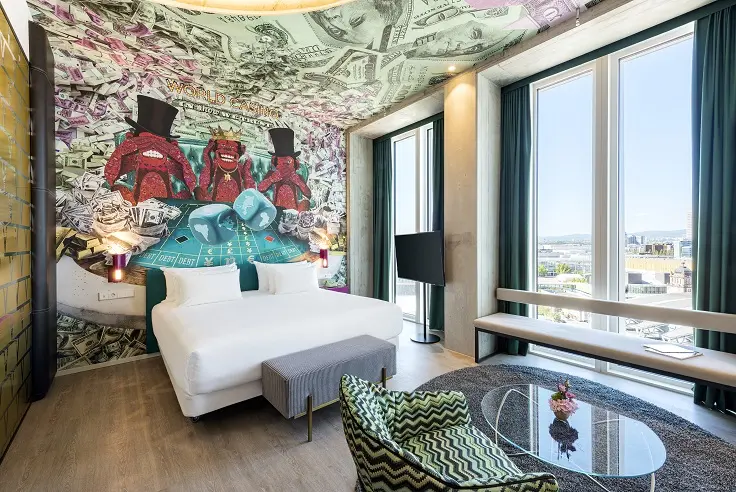
Tecnohotel, a leading specialized media outlet in the national hospitality sector, has published an article dedicated to the iconic art project created for the nhow Frankfurt hotel under the concept “The Art of Money.” This stands as one of the most prominent projects of my career as a spatial artist for hotels.
Under the title “Spanish Design and Murals for the New nhow Frankfurt,” the article discusses my Pop Art-style murals (also influenced by urban art) for the guest rooms, suites, and SkyBar. Fused with the hospitality design of the famous Rafael de La Hoz studio, the proposal transcends the visual to become experiential.
From Contemplation to Interaction
The shift from the traditional contemplative dimension of art for spaces to a new context of experiences is evidenced by the multiple interactions of guests with the artworks, documented through hundreds of videos and images on social media. The guest-art-interior design interaction becomes visible through the recreation of scenes where guests become co-protagonists of the action, extending the symbolism of the art through their contributions to the story unfolding within the visual piece.
Traditionally, hospitality art has been contemplative. The guest played a passive role as a spectator, and the distance between the artwork and the individual transcended the physical plane. This new generation of hospitality design creates a synergy between three disciplines (art, interior design, architecture), allowing spaces to express spatial storytelling so immersively that the guest can interact with their environment and feel like an active part of it.
Is It Necessary? What Does It Contribute?
To answer in order: it is not a matter of whether it is necessary or not. What is strictly “necessary” in the hospitality sector could be reduced to an enclosed space, a bed, and a toilet. It is about added value.
Hospitality spaces are much more than a place to sleep; they are experiential proposals, as the guest lives an experience that forms part of their journey. Regarding the second question—what it contributes is intangible but deeply transformative value. The memories the guest retains of their experience—which will form part of their travel memories—are enriched through that creative interaction with the hotel’s proposal.
The Business Case for Experiential Art
This new generation of art for spaces, which is experiential and fuses with interior design and architecture, has a meaning and a purpose. It generates a reward:
For the guest: From an experiential, cognitive, and emotional point of view.
For the hotel ownership: From the perspective of quality and added value offered by their accommodation proposal. This undoubtedly results in benefits regarding Customer Loyalty, reputation, viralization, and attraction of younger generational sectors (Millennials, Gen Z).
Society has changed and demands new dynamics, new perspectives, and a renewed offer that surprises, seduces, and brings added value to travel. The immersive art I have created for hotels like nhow Frankfurt demonstrates that this proposal works and achieves all the objectives mentioned in this article. Perhaps the only thing remaining is for the Hospitality sector as a whole to transform and leave behind the conservative vision that has characterized it until now, giving way to the “Hospitality 2.0” that new generations of travelers are demanding.