
THE FUTURE IS NOT DIGITAL. IT IS EXPERIENTIAL
From 2022 to 2029: the future is no longer what it used to be
If between 2022 and today we have witnessed how Generative Artificial Intelligence has transformed the digital world so deeply that it is now almost impossible to tell whether an image or a video is real or synthetic, what can we expect from the next three years—especially considering that this technology evolves geometrically?
I don’t believe that, in 2026, it is still possible to compete in the current landscape by betting only on reproducible visual ideas. How can you differentiate yourself in a context where each concept is copied, cloned, and viralized within minutes? Where, no matter what you do today, thousands of other creators will be replicating it tomorrow?
Experiential design that breaks the prison of pixels
Brands progressively lost interest in investing in real‑world branding actions in favor of those confined to the digital universe, seduced by the promise of greater control and more measurable engagement with their audiences. The paradox is that, precisely at the moment when digital content is at its peak, this control is being lost. Retention, genuine attention, and loyalty are escaping from the screens.
In a digital world immersed in chaos, the physical world is reclaiming its status as the asset it has always been. Nothing surpasses what you can experience through all your senses. The pixels on a screen will never fully emulate the emotions, sensations, and memories generated by a lived experience in a physical environment, in a specific, real context.
The shift that will define the path
And this is where experiential design appears as a strategic response—not as a design trend, but as a new way to relate to the audience. Experiential design is the future because it turns real contexts into storytelling that until now was almost exclusively reserved for the digital sphere. Instead of conveying emotions through content consumed in an endless scroll, experiential design constructs them in space, in time, and in the body.
Digital‑native generations—millennials, Gen Z and Gen Beta, and all those that come after—will begin to value the tangible as an oasis in the face of permanent overexposure to stimuli from the infinite scroll. In this context, experiential design becomes a key asset for hospitality, retail, cultural, and corporate spaces.
Those hospitality environments that grasp this window of opportunity will achieve a differentiation as valuable and unique as that of the early pioneers of the internet. But now the key to new‑era branding is not in the screens, nor solely in traditional graphic design: it lies in an experiential design that unites the most immersive visual storytelling to real contexts in which the visitor can feel part of a living narrative.
Branding, aesthetics, and narrative
The physical world returns not as nostalgia, but as evolution. It is not about repeating old formulas or simply “decorating spaces,” but rather about designing three‑dimensional narrative systems where every element—light, material, sound, circulation, interaction—forms part of a coherent language. In this sense, experiential design moves beyond the mere role of embellishment and positions itself as a strategic discipline of branding.
While digital content is consumed, experiential spaces are inhabited. And within that inhabitation something occurs that artificial intelligence cannot replicate: the construction of emotional memory tied to a unique, localized, physically grounded context. There is no prompt capable of generating the exact sensation of entering a hotel, a restaurant, or a cultural center, perceiving its atmosphere, crossing paths with other people, and feeling part of a living scene.
Here the designer ceases to be only a creator of images and becomes a director of experience. No longer designing isolated pieces, but narrative sequences that unfold in time and space. No longer communicating punctual messages, but building worlds that are traversed and felt. And this demands a way of thinking closer to cinema, to theater, or to narrative architecture than to traditional branding.
The real differentiation will no longer lie so much in technical execution—which will become increasingly accessible and replicable—but in intention. In the ability to create experiences with meaning, with a solid narrative, and with a sensitivity that resonates amid the emotional expectations of an audience saturated with empty stimuli. And, in terms of positioning, the term “experiential design” begins to gain strategic weight for brands, studios, and spaces that seek to escape digital saturation.
In the coming years we will see how hospitality environments evolve toward hybrid territories where design, technology, and narrative integrate invisibly. Places that are not only visited, but remembered, shared, and reinterpreted. Spaces that function as cultural platforms rather than as mere services. And in all these cases, experiential design will be the thread that transforms a physical environment into a sensory script.
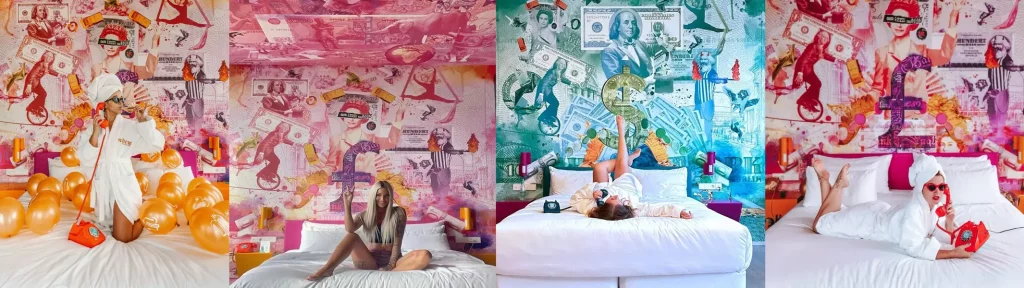
David Zuker's experiential design for the rooms and suites of nhow Roma Hotel